Best Buys
Marine marvels
When you're next in Kuala Terengganu, try cavorting with marine
batik -- the latest trend in a traditional product.
By Andrew Sia / Pix by Tan Hong Tatt, Mohd Sazuki Embong and
courtesy of Batik Gallery.
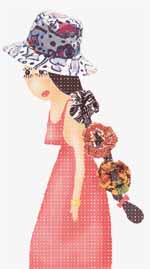
Our WeekEnder model is wearing a batik hat (RM10.50) and batik scrunchies (RM3.50)
in her hair.
|
TECHNICOLOUR fish, dolphins and turtles frolic with abandon
against a brilliant backdrop of blue, green or red. Sharks and jellyfish float around,
waiting for unsuspecting prey to pass by.
Wear all this on you as a shirt or cheongsam, and you have
something called marine batik. Thanks to the tourist traffic along the quaint streets of
old Kuala Terengganu's chinatown, there's been something of a batik revival in recent
years.
One designer here has, however, managed to break away from the
traditional flowery and geometric patterns that have reigned supreme over local batik and
moved into bold innovative designs.
Alex Lee, who runs the Batik Gallery, is now promoting his
"marine collection" featuring, well, just about every marine creature you might
imagine.
"It started out as a hobby. I just used to do a bit of
designing on the computer. Now, the business has grown," explains Alex, who also runs
a travel agency called Ping Anchorage.
"These batik designs leave you with something to remember a
holiday in Terengganu by."
Alex, being a diver himself, has long appreciated the beauty of
coral ecology in the offshore islands of Redang, Perhentian and Tenggol. And now it's been
transplanted onto batik.
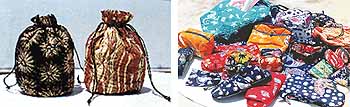
Batik Gallery has a wide range of products featuring marine batik, from slippers
(RM10.50) to oven mittens (RM6.50) to zip purses (RM4.50).
|
Joining the dolphins, turtles and sharks are all the creatures
that snorkellers and divers are familiar with: barracudas, lion fish, clown fish, starfish
and puffer fish.
"Next, I'll be adding on designs based on sea fans, manta
rays, hammerhead sharks and nudie branches."
In addition to these marine creatures, there are also designs
incorporating elements from Ping Anchorage's jungle expeditions: pitcher plants, bamboo,
cempaka flowers, wood grain, the good old hibiscus and even striped tiger
patterns.
This rich variety of designs is tranferred onto cotton or rayon
fabrics via the traditional "block-printing" method of Terengganu batik.
Imported colour-fast Bayer dyes are used to impart stronger, more vibrant hues.
Up to five colours can be printed, producing for instance, red
starfish, yellow angelfish, grey sharks and green turtles amidst a dark blue background.
Of course, more subdued, monochromatic designs are also available, my personal favourites
being shirts and bermuda shorts in two shades of blue.
In any case, tourists will be spoilt for choice. Apart from the
spectrum of designs, the actual products bearing marine batik are equally diversified. Not
only are there shirts, cheongsams, sarongs, parios, shorts and scarves; but also golfhats,
handbags, handkerchiefs, coin pouches, letter holders, slippers and, what d'ya know, oven
mittens!
Besides the outlet in Kuala Terengganu, Faruzi, a retailer at
Kuala Lumpur's Central Market also carries Alex's designs - which are changed every few
months because, he says, copying is rampant.
Well, whatever one's opinion might be on copyright issues, it
remains a trueism that imitation is the best form of flattery.
Alex Lee runs the Batik Gallery in Kuala Terengganu and does
his own designs inspired by his forays underwater. The cheongsam (left) is RM48 and mens
shirt RM38.
Tel: 09-626 2020
Copyright © 1999. Star
Publications (Malaysia) Bhd. (Co No. 10894-D)
All rights reserved.